
Barracks and Unaccompanied Housing Roofing in Killeen, TX
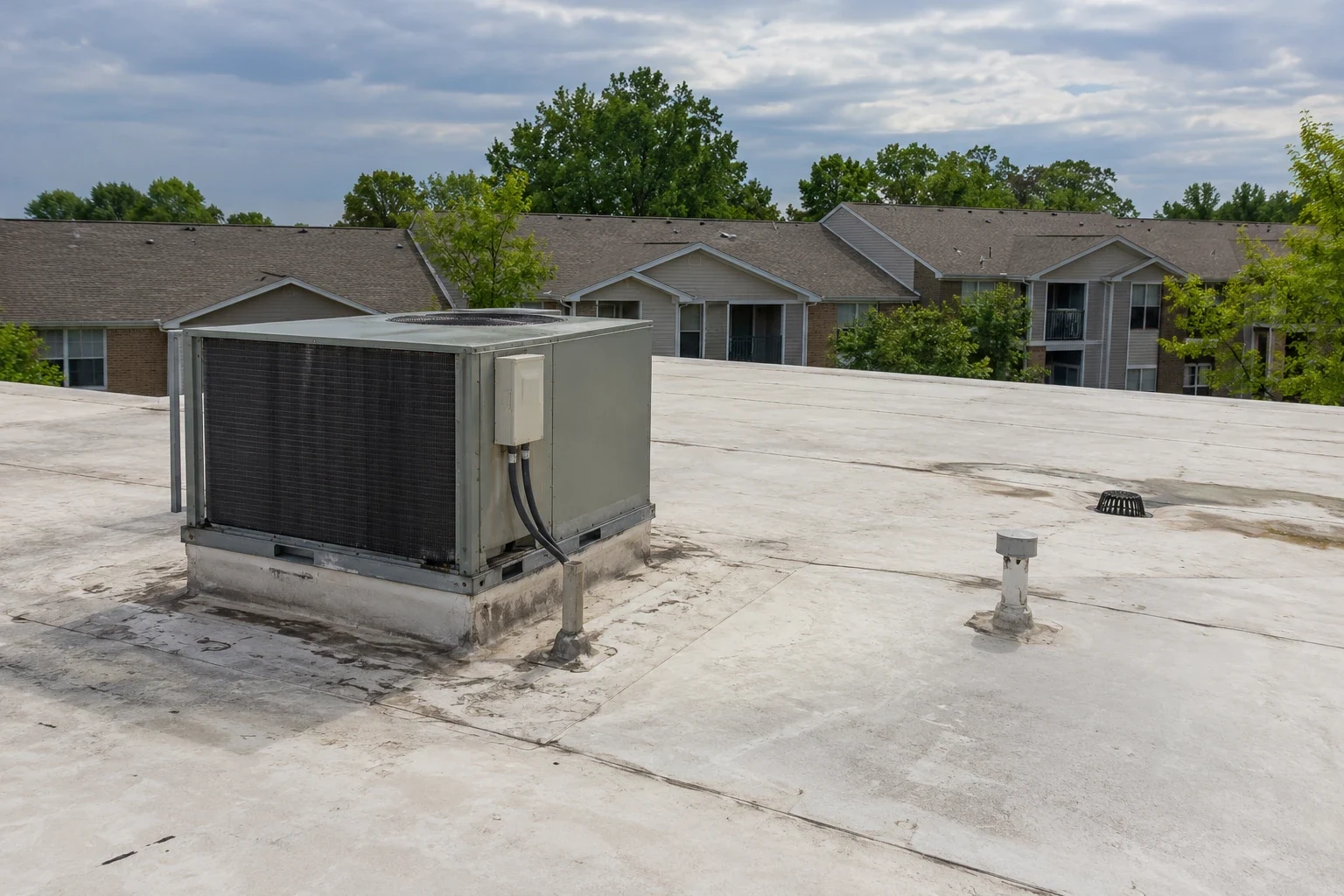
Housing remains occupied in ways that change how a roof project is planned. A leak above a room, corridor, common area, or service space needs a location-specific response, and roof access must not create an avoidable disruption below. We begin with the building contact, reported conditions, roof assembly, and the areas residents or staff need to keep using. The owner approves entry, escort, resident communication, and work hours. A roofing assessment does not imply access approval or a relationship with an individual installation.
In Killeen, heat and severe-weather history make seams, perimeter metal, flashing, penetrations, and drainage worth documenting. Those conditions help frame an inspection; they do not prove a particular housing roof is damaged. We compare interior reports to roof sections, then separate immediate protection from a permanent repair option. A roof condition inspection can establish the observation record, while occupied-building phasing can set practical work limits for an owner-approved schedule.
How can work limit disruption to occupied rooms?
We identify the proposed work area, access route, overhead protection and daily closeout before the crew mobilizes. A temporary opening must be secured against weather before the shift ends, and materials should not block an exit, service path or resident route. The facility contact determines whether notice, room access or a temporary relocation is needed. We show which building areas could be affected, what work creates noise or vibration, and when operations need a clear path. Those details allow the owner to set resident communication without guessing at the crew's sequence.
If repair requires entry to a unit or ceiling space, that permission is separate from roof access. We can map the reported stain, photograph the roof detail above it, and indicate where water could have traveled through the deck or framing. The stain does not automatically locate the breach. A leak investigation keeps the suspected entry point and confirmed repair boundary distinct. Where insulation condition remains uncertain, a moisture survey or owner-approved test opening may help decide whether the repair area should expand.
What should a roof walk follow after a leak report?
We begin at the reported room or corridor, note when the water appeared, and compare that account with the roof plan. On the roof, the review follows drainage paths, low points, seams, perimeter transitions and penetrations near the likely travel route. Leaves or debris at a drain can contribute to ponding, while an open lap or failed curb detail may admit water elsewhere. We record the condition we see and do not claim a cause until the evidence supports it. If a section is inaccessible, its status remains unresolved.
For a low-slope membrane, we look at field seams, patches, flashing height, scuppers and roof-mounted equipment supports. On sloped sections, we check panel laps, fasteners and eave transitions. A wet insulation indication may be localized, but the boundary requires confirmation before the owner prices removal or recovery. An apartment roof section can share occupied-building concerns, while a medical roof area brings a different operational profile. The actual housing assembly and access plan decide the scope.
Which local conditions belong in a housing roof file?
Within the 1991 to 2020 normals, daily highs reach 100 degrees on an average of 18.3 Killeen days each year. A hot roof can affect application conditions for repair materials and coatings, so we verify the conditions at the work area instead of relying on a city normal to approve a product. The record is useful for seasonal planning and for explaining why a coating step may need a different work window.
Killeen's March 25, 2003 weather entry pairs an F0 tornado with hail measured at 1.75 inches. Historic observations point us toward checking present metal edges, exposed membrane, equipment curbs and interior reports after a current concern, but they do not establish damage at housing. US 190, SH 195 and SH 201 are part of the arterial network that informs regional delivery planning in Killeen. Those corridors connect commercial areas in Killeen and Harker Heights; they can inform material delivery planning, not determine access at an individual property. For a Killeen roof assessment, the facility contact sets the approved entry and resident-safety route; we use that direction to plan material arrival and roof access.
How should repair and renewal options be compared?
A localized repair fits when the opening is found, the surrounding membrane or panel remains serviceable, and a compatible detail can be installed. The scope names that roof section and the adjacent transitions inspected. If leaks recur at different locations or test openings show broader wet insulation, we compare repair with section replacement rather than expand a patch without evidence. A coating or recovery option needs a suitable substrate, secure attachment, acceptable moisture conditions, workable drainage and adequate edge height.
Replacement planning should state what is removed, what remains, how insulation and cover board are handled, and how curbs, drains, edges and penetrations are closed each day. For Killeen projects, the amended 2024 International Building Code took effect on January 1, 2026; the project team confirms the permit path for the actual scope. The project team confirms the applicable code and permit requirements for the actual scope. A TPO assembly may be considered where the deck and project conditions support it; EPDM or another system can be compared on the same section boundary. The proposal should show assumptions and owner decisions separately.
What should be tracked between roof visits?
Maintain a roof register that ties each reported leak, repair, photograph and test result to a labeled section. Include the date, weather condition, access limits, temporary protection and whether the interior concern returned. A record that notes only the building name makes it difficult to determine whether a later report is at the same detail or a different drain, seam or penetration. Section-level history helps the asset team decide whether a repair remains isolated or is becoming a replacement-cycle issue.
For occupied housing, retain the approved work hours, resident notice plan, staging location and closeout inspection alongside the contractor's scope. We can return a condition report that distinguishes observed damage, unresolved areas, and any assumptions about concealed material. Send roof drawings, prior work orders, interior leak locations and the decision date. Then we can present a repair boundary and a broader renewal alternative, with what each option includes and what evidence could change the recommendation.
Commercial Roofing Questions
Can residents remain in the building during a reroof?
The owner decides which areas may remain occupied and what protections are required. We can divide work into approved sections, identify noise, overhead and access concerns, and specify how each area will be made weather-tight at shift end.
What should staff report when water appears indoors?
Record the room or corridor, date, weather, and whether the condition is active. We compare that report with roof details above and around the area, while keeping the visible stain separate from the confirmed entry point.
Will a coating stop a recurring barracks leak?
A coating is an option only if the existing roof is suitable, dry enough, attached securely, and able to drain. We inspect the substrate and details first; active leaks or widespread wet insulation may call for another scope.
How do we handle roof access over occupied space?
The facility contact approves the route and time. Our plan identifies staging, overhead protection, room-entry limits and the daily closure, with any restricted or inaccessible section listed in the report.
Does storm history establish that housing needs replacement?
No. Regional records can guide inspection priorities, but replacement depends on present assembly condition, test results, repair history and remaining serviceability. We document those findings by roof section.
Tie housing concerns to a roof section
Provide the roof plan, reported leak locations, resident access rules, prior repair records and available work windows. We can document approved areas, define the repair boundary and compare that scope with section renewal.